In the oil and gas industry, seals play a crucial role in ensuring the safe and efficient operation of equipment. Among the various types of seals, static and dynamic oil and gas seals are two fundamental categories, each with its own unique characteristics, applications, and performance requirements. As a professional oil and gas seals supplier, I'd like to delve into the differences between these two types of seals to help our customers make more informed decisions.
Definition and Basic Principles
Static seals are designed to prevent the leakage of fluids or gases between two stationary components. They are typically used in applications where there is no relative motion between the sealing surfaces. For example, in a pipeline flange connection, a static seal such as a gasket is placed between the two flanges to create a tight seal and prevent the escape of oil or gas. The basic principle of a static seal is to rely on the compression force exerted on the seal material to fill the microscopic irregularities on the sealing surfaces, thereby achieving a leak - tight connection.
On the other hand, dynamic seals are used in applications where there is relative motion between the sealing surfaces, such as rotating shafts or reciprocating pistons. The main function of a dynamic seal is to prevent the leakage of fluids or gases while allowing the moving parts to operate smoothly. Dynamic seals need to withstand not only the pressure of the fluid or gas but also the frictional forces generated by the relative motion. For instance, in a pump, a dynamic seal is used to prevent the leakage of the pumped fluid along the rotating shaft.
Material Selection
The choice of materials for static and dynamic seals is significantly different due to their different operating conditions.
For static seals, materials with good compressibility, resilience, and chemical resistance are preferred. Common materials include rubber (such as nitrile rubber, EPDM rubber), graphite, and PTFE. Nitrile rubber is widely used in static seals for oil and gas applications because of its excellent resistance to oil and fuel. Graphite is often used in high - temperature and high - pressure static sealing applications due to its high thermal stability and chemical inertness. PTFE has low friction coefficient and excellent chemical resistance, making it suitable for static seals in corrosive environments.
In the case of dynamic seals, materials need to have good wear resistance, low friction coefficient, and the ability to adapt to the relative motion. Some of the commonly used materials for dynamic seals are carbon, ceramic, and certain types of polymers. Carbon is a popular choice for dynamic seals in pumps and compressors because of its self - lubricating properties and good wear resistance. Ceramic materials are used in high - speed and high - pressure dynamic sealing applications due to their high hardness and excellent wear resistance. Polymers such as PEEK (polyether ether ketone) are also increasingly being used in dynamic seals because of their good mechanical properties and chemical resistance.
Design and Structure
The design and structure of static and dynamic seals also vary greatly.
Static seals usually have a relatively simple structure. Gaskets, which are a common type of static seal, can be in the form of flat gaskets, spiral wound gaskets, or ring gaskets. Flat gaskets are the simplest type, made of a single layer of sealing material and are suitable for low - pressure applications. Spiral wound gaskets are composed of a metal strip and a filler material wound together in a spiral shape, providing better sealing performance under high - pressure and high - temperature conditions. Ring gaskets, such as octagonal or oval ring gaskets, are used in high - pressure flange connections and rely on the metal - to - metal contact for sealing.
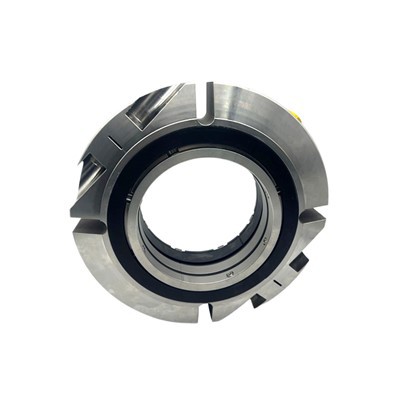
Dynamic seals, however, have more complex designs. For example, mechanical seals, which are widely used in dynamic sealing applications, consist of several components, including a rotating ring, a stationary ring, a spring, and secondary seals. The rotating ring is attached to the rotating shaft, while the stationary ring is fixed to the housing. The spring provides the necessary axial force to keep the two rings in contact, creating a sealing interface. There are also different types of mechanical seals, such as balanced and unbalanced mechanical seals. For more information about specific mechanical seals, you can refer to our 502 Replacement Single Spring Bellow Mechanical Seal for Petrochemical Industry, Equivalent to type 2 mechanical seal, and John Crane 112 Replacement Unbalanced mechanical seal.
Performance and Reliability
When it comes to performance and reliability, static and dynamic seals have different requirements and characteristics.
Static seals are generally more reliable in terms of long - term sealing performance because there is no relative motion between the sealing surfaces, which reduces the wear and tear on the seal. Once properly installed, a static seal can maintain a good sealing effect for a long time, provided that the operating conditions such as temperature, pressure, and chemical environment do not exceed the seal's design limits. However, static seals may be more sensitive to installation errors. If the gasket is not installed correctly, for example, if it is not centered properly or the compression force is not evenly distributed, it can lead to leakage.
Dynamic seals, on the other hand, face more challenges in terms of performance and reliability. The relative motion between the sealing surfaces generates frictional heat, which can cause the seal material to wear out over time. In addition, dynamic seals need to adapt to different operating conditions, such as changes in speed, pressure, and temperature. To ensure the reliability of dynamic seals, regular maintenance and inspection are required. For example, the lubrication system of a dynamic seal needs to be checked regularly to ensure that there is sufficient lubrication to reduce friction and wear.
Application Scenarios
The application scenarios of static and dynamic seals are also distinct.
Static seals are commonly used in pipeline connections, valve bonnets, and equipment flanges. In a refinery, static seals are used to seal the joints between different sections of pipelines to prevent the leakage of crude oil, refined products, or other chemicals. In a storage tank, static seals are used to seal the manhole covers and other access points to ensure the safety of the stored materials.
Dynamic seals are mainly used in rotating equipment such as pumps, compressors, and turbines. In a pump, a dynamic seal is used to prevent the leakage of the pumped fluid along the rotating shaft. In a compressor, dynamic seals are used to seal the compression chambers and prevent the leakage of the compressed gas. Dynamic seals are also used in engines, where they are used to seal the pistons and prevent the leakage of combustion gases.
Cost Considerations
Cost is an important factor to consider when choosing between static and dynamic seals.
Static seals are generally less expensive than dynamic seals. The simple design and relatively low - cost materials of static seals make them a cost - effective solution for many applications. However, the cost of installation and replacement should also be taken into account. In some cases, the cost of disassembling and reassembling the equipment to replace a static seal can be significant.
Dynamic seals, on the other hand, are more expensive due to their complex design and the use of high - performance materials. In addition, the cost of maintenance and replacement of dynamic seals is also relatively high. However, considering the critical role that dynamic seals play in the operation of rotating equipment, the investment in high - quality dynamic seals is often justified to ensure the reliable and efficient operation of the equipment.


Conclusion
In conclusion, static and dynamic oil and gas seals have significant differences in terms of definition, material selection, design, performance, application scenarios, and cost. As an oil and gas seals supplier, we understand the unique requirements of each type of seal and are committed to providing our customers with the most suitable sealing solutions. Whether you need a reliable static seal for a pipeline connection or a high - performance dynamic seal for a pump, we have the expertise and products to meet your needs.
If you are interested in our oil and gas seals products or have any questions about sealing solutions, please feel free to contact us for procurement and further discussions. We look forward to working with you to ensure the safe and efficient operation of your oil and gas equipment.
References
- ESDU International. Engineering Sciences Data Unit. "Sealing Technology: Static and Dynamic Seals".
- API (American Petroleum Institute) Standards. "Sealing Requirements for Oil and Gas Equipment".
- ASME (American Society of Mechanical Engineers) Codes. "Codes and Standards for Pressure Vessels and Piping Seals".